


Financial position
Financial management policies and goals
The financing strategy of Fresenius has the following main objectives:
Ensuring financial flexibility
Maintaining our investment-grade rating
Limiting refinancing risks
Optimizing our cost of capital
Ensuring financial flexibility is key to the financing strategy of Fresenius. To remain financially flexible, we maintain adequate liquidity headroom. We are committed to our investment-grade rating, which provides us with advantages with respect to funding costs, facilitates markets access, and thus contributes to greater financial flexibility overall. Our financing strategy aims at ensuring a stable investment grade rating in the long term.
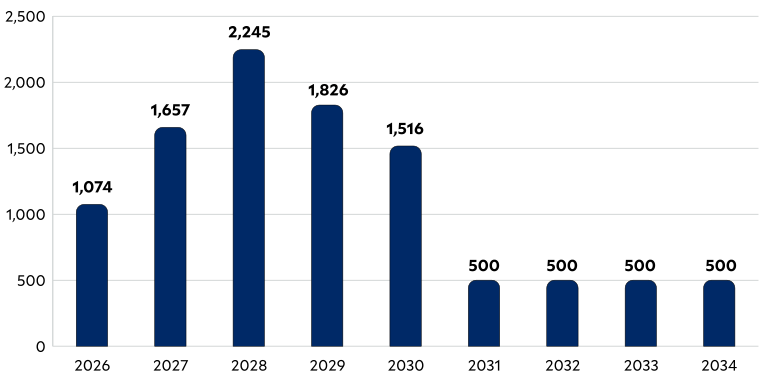
Refinancing risks are limited due to a balanced maturity profile which is characterized by a broad range of maturities with a high proportion of mid- and long-term debt. We use various financing instruments in a targeted manner to diversify our financing mix and our investor base.
Another key objective of Fresenius’ financing strategy is to optimize the cost of capital by employing an adequate mix of equity and debt. Due to the Company’s diversification within the healthcare sector and the strong market positions of its business segments in global, growing, and non-cyclical markets, we are able to generate predictable and sustainable cash flows.
Overall, there were no significant changes in our financing strategy in 2025. Fresenius pursued a stringent capital allocation focused on organic growth and deleveraging. The Company continued to make good progress in reducing its leverage ratio (net debt to EBITDA1). As of December 31, 2025 the leverage ratio was 2.7×1 (December 31, 2024: 3.0×1) and thus well within the self-imposed target corridor of 2.5× to 3.0×.
In fiscal year 2025, long-term maturities of approximately €3.5 billion were repaid, including approximately €1.1 billion repaid ahead of their maturity dates. This compares with new long-term financings of approximately €2 billion in the form of bonds, an exchangeable bond, and a loan from the European Investment Bank.
In 2026, adherence to our self-imposed target corridor will continue to be of central importance to us. Planned financing activities in 2026 will be largely geared towards refinancing existing financial liabilities maturing in 2026 and in the first quarter of 2027.
Our self-imposed target corridor of 2.5× to 3.0× allows us to stay financially flexible while solidifying our investment-grade rating.
Financing
Fresenius meets its financing needs through a combination of operating cash flows generated in the business segments and short-, mid-, and long-term debt. Important financing instruments include bonds, Schuldschein loans, bank loans, a commercial paper program, accounts receivable programs, and lease liabilities. In the selection of financing instruments, we take into account criteria such as market capacity, investor diversification, funding flexibility, cost of capital, and the existing maturity profile. We also consider the currencies in which our returns and cash flows are generated.
Financing mix of the Fresenius Group1
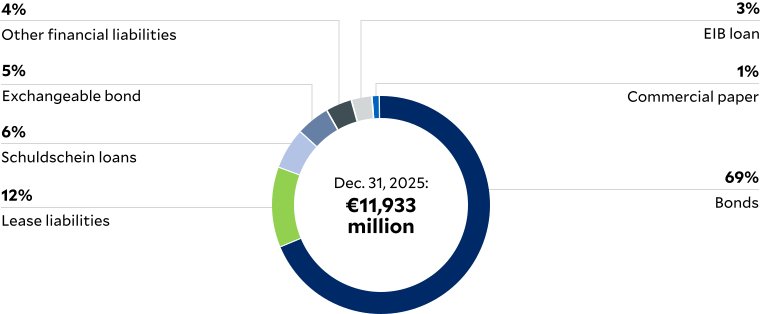
Fresenius pursues a centralized financing strategy. The business segments Fresenius Kabi and Fresenius Helios are financed primarily through Fresenius SE & Co. KGaA in order to avoid structural subordination. Currency derivatives are used at Group level to hedge intercompany loans in foreign currencies.
The bond market is our main source of funding for mid- and long-term financing. Fresenius SE & Co. KGaA has a Debt Issuance Program, under which bonds of up to €15 billion can be issued in different currencies and maturities. In 2025, Fresenius SE & Co. KGaA successfully placed bonds with an aggregate volume of €1 billion across two tranches. At year-end 2025, the Debt Issuance Program was utilized with approximately €8.3 billion.
In addition, Fresenius SE & Co. KGaA placed an exchangeable bond of €600 million and received a €400 million loan from the European Investment Bank.
For short-term financing needs, Fresenius SE & Co. KGaA maintains bilateral credit lines and a commercial paper program. Under the commercial paper program, short-term notes of up to €1.5 billion can be issued. As of December 31, 2025, €70 million of the commercial paper program was utilized.
The €2 billion syndicated ESG-linked credit facility of Fresenius SE & Co. KGaA signed in July 2021 serves as a backup line and was undrawn as of December 31, 2025.
The proceeds of the financing activities in 2025 were mainly used for general corporate purposes, including the refinancing of existing financial liabilities.
The average maturity of our major financing instruments (excluding leasing) as of December 31, 2025 was 3.4 years and the average interest rate was 2.3%.
Detailed information on Fresenius’ financing activities can be found in notes 26, Debt, 27, Bonds, and 28, Bonds – exchangeable bond, of the notes. Further information on financing measures in 2026 is included in the Outlook section.
€ in millions |
|
2025 |
|
2024 |
|
2023 |
|
2022 |
|
2021 |
||||
|---|---|---|---|---|---|---|---|---|---|---|---|---|---|---|
Cash conversion rate |
|
1.1 |
|
1.1 |
|
1.0 |
|
0.9 |
|
0.9 |
||||
Investments in property, plant and equipment, net |
|
813 |
|
916 |
|
1,026 |
|
1,089 |
|
2,017 |
||||
Cash flow before acquisitions and dividends |
|
1,882 |
|
1,623 |
|
1,130 |
|
942 |
|
1,401 |
||||
as % of sales |
|
8.3% |
|
7.5% |
|
5.6% |
|
4.4% |
|
7.0% |
||||
|
||||||||||||||
Maturity profile of the Fresenius Group financing facilities1
Corporate credit rating
The credit quality of Fresenius is assessed and regularly reviewed by the leading rating agencies Standard & Poor’s, Moody’s, and Fitch. In fiscal year 2025, there were no changes to the corporate credit rating of Fresenius SE & Co. KGaA. Fresenius SE & Co. KGaA is rated investment grade by all three rating agencies with a stable outlook. On August 14, 2025, Fitch affirmed the corporate credit rating at BBB- and the outlook at stable.
|
|
Dec. 31, 2025 |
|
Dec. 31, 2024 |
|---|---|---|---|---|
Standard & Poor’s |
|
|
|
|
Corporate credit rating |
|
BBB |
|
BBB |
Outlook |
|
stable |
|
stable |
Moody’s |
|
|
|
|
Corporate credit rating |
|
Baa3 |
|
Baa3 |
Outlook |
|
stable |
|
stable |
Fitch |
|
|
|
|
Corporate credit rating |
|
BBB- |
|
BBB- |
Outlook |
|
stable |
|
stable |
Effect of off-balance-sheet financing instruments on our financial position and liabilities
Fresenius does not use any off-balance-sheet financing instruments that are likely to have a significant impact on its financial position, results of operations, liquidity, investments, assets and liabilities, or capitalization at present or in the future.
Liquidity analysis
The main sources of liquidity are cash provided by operating activities and by financing activities. Cash flows from operating activities are influenced by the profitability of Fresenius’ business and by change in working capital, in particular receivables. Cash inflows from financing activities are generated through the use of various short-, mid-, and long-term financing instruments. For short-term financing, we issue commercial paper and draw on bilateral bank credit lines. Short-term liquidity requirements can also be covered by accounts receivable programs. Mid- and long-term financing is mainly provided by bonds, Schuldschein loans, bilateral bank credit lines, and leasing liabilities. In addition, Fresenius has access to a €2 billion syndicated revolving credit facility as additional liquidity headroom. Fresenius is confident that cash inflows from operating activities and short-, mid-, and long-term funding sources will be sufficient to cover the Group’s foreseeable liquidity needs.
Dividend
Fresenius is committed to generating attractive and predictable dividend yields as set out in the Fresenius Financial Framework. As part of the full-year reporting in February 2025, Fresenius defined a new dividend policy. Our target is to distribute 30% to 40% of core net income (net income excluding Fresenius Medical Care, before special items). The new dividend policy reflects the capital allocation priorities in line with the #FutureFresenius strategy. It also underscores our intention to reinvest in growth, reduce leverage, maintain a solid investment-grade rating, and provide attractive shareholder returns.
Fresenius will propose to the 2026 Annual General Meeting to distribute a dividend of €1.05 for fiscal year 2025. This corresponds to a payout ratio of around 37%.
Cash flow analysis
Operating cash flow increased by 5% to €2,574 million (2024: €2,447 million). Operating cash flow in fiscal year 2025 was mainly driven by the good operational development at Fresenius Kabi and Fresenius Helios. The cash flow margin was 11.4% (2024: 11.4%).
Capital expenditures (net) amounted to -€813 million (2024: -€916 million). As a result, the cash flow before acquisitions and dividends was €1,882 million (2024: €1,623 million).
The net cash inflow for acquisitions amounted to €228 million. Acquisition expenses mainly related to already-planned milestone payments in connection with the acquisition of the biosimilars business of Merck KGaA at Fresenius Kabi. Cash inflows were mainly due to the sales of shares in Fresenius Medical Care.
Dividends of the Group in total amounted to a cash outflow of €563 million (2024 cash inflow: €112 million). The dividend amount is calculated as follows: In total, there was a dividend payment of €563 million to the shareholders of Fresenius SE & Co. KGaA and dividends paid to third parties of €121 million. These payments were partially offset by the dividend of €121 million that Fresenius SE & Co. KGaA received as a shareholder of Fresenius Medical Care.
Free cash flow after acquisitions and dividends (continuing operations) was €1,458 million (2024: €1,859 million).
Payments from lease liabilities resulted in a cash outflow of €173 million (2024: -€180 million).
As a result, the free cash flow after acquisitions, dividends, and leases (continuing operations) amounted to €1,285 million (2024: €1,679 million).
Cash used for financing activities was €1,949 million, (2024: -€1,925 million). The sale of shares in Fresenius Medical Care had a positive effect.
Cash and cash equivalents (net), as a result, decreased by €697 million, as of December 31, 2025. They were negatively influenced by currency translation effects of €33 million (2024: -€2 million).
The cash conversion rate (CCR), which reflects the ratio of adjusted free cash flow to EBIT before special items, was 1.1 in fiscal year 2025 (2024: 1.1).
Working capital increased by 4% to €4,697 million (2024: €4,514 million).
€ in millions |
|
2025 |
|
2024 restated |
|
2024 previous |
|
Growth |
|
Margin 2025 |
|
Margin 2024 |
|---|---|---|---|---|---|---|---|---|---|---|---|---|
Net income |
|
1,606 |
|
1,152 |
|
867 |
|
39% |
|
|
|
|
Depreciation and amortization |
|
1,120 |
|
1,239 |
|
1,204 |
|
-10% |
|
|
|
|
Gain / Loss from investments accounted for using the equity method |
|
-198 |
|
-38 |
|
-38 |
|
-- |
|
|
|
|
Change in working capital and others |
|
78 |
|
120 |
|
368 |
|
-35% |
|
|
|
|
Operating cash flow – continuing operations |
|
2,606 |
|
2,474 |
|
2,401 |
|
5% |
|
|
|
|
Operating cash flow – discontinued operations |
|
-32 |
|
-27 |
|
46 |
|
-19% |
|
|
|
|
Operating cash flow |
|
2,574 |
|
2,447 |
|
2,447 |
|
5% |
|
11.4% |
|
11.4% |
Capital expenditure, net |
|
-813 |
|
-916 |
|
-916 |
|
11% |
|
|
|
|
Dividends received from Fresenius Medical Care |
|
121 |
|
112 |
|
112 |
|
8% |
|
|
|
|
Cash flow before acquisitions and dividends – continuing operations |
|
1,914 |
|
1,670 |
|
1,597 |
|
15% |
|
|
|
|
Cash flow before acquisitions and dividends – discontinued operations |
|
-32 |
|
-47 |
|
26 |
|
32% |
|
|
|
|
Cash flow before acquisitions and dividends |
|
1,882 |
|
1,623 |
|
1,623 |
|
16% |
|
8.3% |
|
7.5% |
Cash used for acquisitions, net |
|
228 |
|
189 |
|
314 |
|
21% |
|
|
|
|
Dividends paid |
|
-684 |
|
– |
|
– |
|
-- |
|
|
|
|
Free cash flow after acquisitions and dividends – continuing operations |
|
1,458 |
|
1,859 |
|
1,911 |
|
-22% |
|
|
|
|
Payments from lease liabilities |
|
-173 |
|
-180 |
|
-181 |
|
4% |
|
|
|
|
Free cash flow after acquisitions, dividends, and leases – continuing operations |
|
1,285 |
|
1,679 |
|
1,730 |
|
-23% |
|
|
|
|
Free cash flow after acquisitions, dividends, and leases – discontinued operations |
|
-383 |
|
37 |
|
-14 |
|
-- |
|
|
|
|
Free cash flow after acquisitions and dividends |
|
902 |
|
1,716 |
|
1,716 |
|
-47% |
|
|
|
|
Cash provided by / used for financing activities |
|
-1,949 |
|
-1,925 |
|
-1,976 |
|
-1% |
|
|
|
|
Effect of exchange rates on change in cash and cash equivalents |
|
-33 |
|
-2 |
|
-2 |
|
-- |
|
|
|
|
Net change in cash and cash equivalents |
|
-697 |
|
-248 |
|
-248 |
|
-181% |
|
|
|
|
Investments and acquisitions
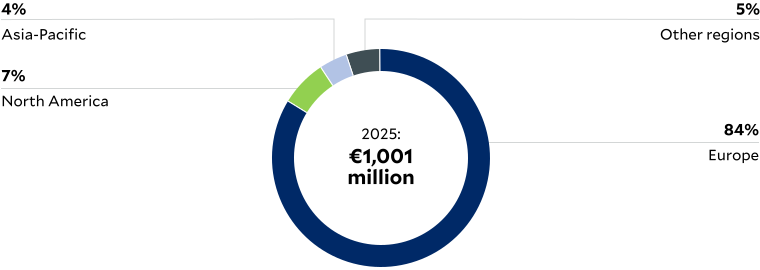
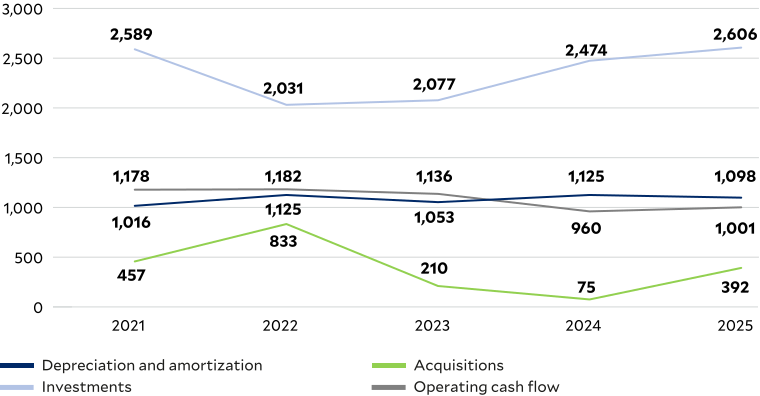
In 2025, the Fresenius Group spent €1,393 million (2024: €1,035 million) on investments and acquisitions. Investments in property, plant and equipment increased to €1,001 million (2024: €960 million) or 4.4% of revenue (2024: 4.5%). This was below the depreciation level2 of €1,098 million. A total of €392 million was invested in acquisitions (2024: €75 million). Of the total capital expenditure in 2025, 72% was invested in property, plant and equipment and 28% was spent on acquisitions.
Acquisition expenses mainly related to already-planned milestone payments in connection with the acquisition of the biosimilars business of Merck KGaA at Fresenius Kabi.
Investments by region
€ in millions |
|
2025 |
|
2024 |
|
Change |
|---|---|---|---|---|---|---|
Acquisitions |
|
392 |
|
75 |
|
423% |
Investment in property, plant and equipment |
|
1,001 |
|
960 |
|
4% |
thereof maintenance |
|
55% |
|
61% |
|
|
thereof expansion |
|
45% |
|
39% |
|
|
Investment in property, plant and equipment as % of revenue |
|
4.4% |
|
4.5% |
|
|
Total investments and acquisitions |
|
1,393 |
|
1,035 |
|
35% |
€ in millions |
|
2025 |
|
2024 |
|
Thereof property, plant and equipment |
|
Thereof acquisitions |
|
Change |
|
% of total |
|---|---|---|---|---|---|---|---|---|---|---|---|---|
Fresenius Kabi |
|
413 |
|
445 |
|
382 |
|
31 |
|
-7% |
|
30% |
Fresenius Helios |
|
597 |
|
524 |
|
537 |
|
60 |
|
14% |
|
43% |
Corporate / Other |
|
383 |
|
66 |
|
82 |
|
301 |
|
480% |
|
27% |
Total |
|
1,393 |
|
1,035 |
|
1,001 |
|
392 |
|
35% |
|
100% |
Investments, acquisitions, operating cash flow, depreciation, and amortization in € millions – Five-year overview1
The main investments in property, plant and equipment were as follows:
-
Optimization and expansion of production facilities for Fresenius Kabi.
-
New building and modernization of hospitals at Fresenius Helios. The most significant individual projects were, among other locations, hospitals in Wiesbaden, Duisburg, Wuppertal, and Niederberg, Krefeld as well as investments in IT infrastructure.
Investment program at Fresenius Kabi
Fresenius Kabi has a global network of production centers. We manufacture our finished medicines in our own plants and, at some sites, also produce active pharmaceutical ingredients. Our investments aim, among other things, to continuously modernize and automate, thus increasing the competitiveness of our plants at a consistently high level of quality.
Nutrition business
In China, we are expanding our production capacity of nutrition products. In the reporting year, we invested in a parenteral nutrition multi-chamber bag line, which was installed by the end of the year.
In the Netherlands, we progressed with our investment into a production line for enteral nutrition sip feeds with a total investment of €36 million. This project is being executed as planned and will be finalized by the end of 2026.
In Sweden, a new project for a parenteral nutrition multi-chamber bag line with a total investment of €12 million was approved in Q2 2025. The project is planned to be completed by mid 2027 and will enlarge our production capacity and strengthen the Swedish facilities’ role as a key manufacturing hub for parenteral nutrition.
MedTech business
In 2025, MedTech invested €50 million in capacity expansion and automation to meet the growing market demand. Our central manufacturing facility for disposable products is our plant in Haina in the Dominican Republic. Driven by the high market demand, we have gradually expanded the plant in recent years. To meet the growing market demand for disposable products, we have started an expansion of our manufacturing plant that will continue in the coming years, with highly automated production equipment and clean-room capacities. As high-end filters are an essential component of many of our disposables, we are investing in the expansion of our filter capacity to support our growing business.
Biopharma business
Biopharma continues to prioritize capacity expansion and efficiency projects to support strong growth targets and ensure supply chain resilience. CAPEX investments in 2025 focused on completing the first drug product vertical integration in Graz (fully automated packaging line for Tocilizumab PFS) as well as an initial downpayment for new drug product capacity expansion for the formulation and filling area of up to €45 million over the coming years.
We continue to invest in our portfolio, primarily with investments to secure long-term competitiveness and cost leadership, predominantly driven by vedolizumab and aflibercept milestones.
Pharma business
In Europe we are continuously expanding our production network for IV Fluids, including the installation of two new high-speed production lines for infusion bottles in our sites in Italy and Poland. The investment entails the full manufacturing process from formulation to packaging and will allow for highly efficient production of sterile IV Fluids in plastic containers.
In India, we have started a significant investment into our production capacities for oncology products. The site produces, among others, lyophilized products in vials for the Indian market as well as Europe, Asia-Pacific, and Latin America.
Divestments
Fresenius Vamed
On May 2, 2024, the Fresenius Group announced that it would sell a majority stake in Vamed’s rehabilitation business to PAI Partners, an international private equity firm. Subsequent to the sale in September 2024, the Fresenius Group held a 30% stake in the business through an investment in Aceso Topco 1 S.à r.l. accounted for using the equity method. Due to a capital increase at Aceso Topco 1 S.à r.l. in June 2025, the Fresenius Group’s stake was decreased to 23.4%. The rehabilitation business, which also includes specialized healthcare services in the areas of prevention, acute care, and nursing, was Vamed’s largest business unit.
On May 8, 2024, the Fresenius Group announced that it had initiated the structured exit from Fresenius Vamed. The original agreement to sell activities of Fresenius Vmed to an Austrian consortium of construction companies Porr and Strabag was replaced by a direct contract with Porr for the sale of the Austrian project business and the thermal spas operations of VAMED Vitality World. The transaction was closed on December 31, 2025 and, including operative results, resulted in a loss of €48 million in 2025, which is reported in net income from discontinued operations.
An agreement on the sale of the international project business of the Health Tech Engineering business to the Worldwide Hospitals Group was reached on January 31, 2025. The transaction was closed on March 31, 2025 and involved the transfer of liquidity and future payment obligations. Including operative results, the sale of the international project business to the Worldwide Hospitals Group resulted in a negative special item of €232 million, which is reported in net income from discontinued operations. Taking into account the expenses already incurred, the expected total special items for the exit from the international project business are in the high-three-digit million euro range. The Fresenius Group also holds bank guarantees for performance commitments in connection with the divested international project business in the low-three-digit million euro range.
The business units of Fresenius Vamed earmarked for sale are reported as separate items (discontinued operations and assets held for sale and liabilities directly associated with the assets held for sale, respectively) in the relevant periods.
After termination of the discussions with Strabag, the remaining parts of Vamed’s Austrian activities have no longer been classified as held for sale in fiscal year 2025.
Further divestitures
On March 4, 2025, the Fresenius Group announced the sale of 10.6 million existing shares of Fresenius Medical Care AG at a placement price of €44.50 per share. Furthermore, the Fresenius Group announced the placement of senior unsecured bonds due in 2028 with an aggregate principal amount of €600 million exchangeable into shares of Fresenius Medical Care AG (see note 28, Bonds – exchangeable bond, of the Notes). In total, the Fresenius Group received gross proceeds of approximately €1.1 billion.
Following the initiation of a share buy-back program by Fresenius Medical Care AG in August 2025, the Fresenius Group has started selling shares of Fresenius Medical Care AG on a pro-rata basis in order to maintain the stake at about 29%. Fresenius Medical Care primarily intends to redeem the repurchased shares or use them to a significantly lesser extent in the context of performance-based compensation plans.
On April 8, 2025, the Fresenius Group signed an agreement to transfer its plant in Anápolis, Brazil, to EMS, a multinational pharmaceutical company. Following the receipt of the regulatory approvals, the transaction was completed on November 30, 2025. The plant has been classified as held for sale since March 31, 2025 until its disposal.
Effective December 31, 2025, the Fresenius Group sold the St. Wendel and Schweinfurt production sites used by Fresenius Medical Care to Fresenius Medical Care Deutschland GmbH for €172 million.
In fiscal year 2025, the Fresenius Group entered into discussions regarding the sale of three hospitals in Germany. Closing of the transactions is subject to required regulatory approvals and is expected to occur within 12 months. The hospitals were classified as held for sale as of December 31, 2025.
In 2023, the Fresenius Group entered into agreements on the divestiture of the Eugin Group and the 70% stake in IDCQ CRP. The transactions were completed in fiscal year 2024.
1 At average exchange rates for both net debt and EBITDA; pro forma closed acquisitions / divestitures, before special items, including lease liabilities, including Fresenius Medical Care dividend, net debt adjusted for the valuation effect of the exchangeable bond
2 Before special items
For a detailed overview of special items please see section Reconciliation Fresenius Group.
Core Net income is calculated from the net income attributable to shareholders of Fresenius SE & Co. KGaA before special items, less the earnings contributions of Fresenius Medical Care.
Core Net income serves, among other purposes, as the basis for calculating Core Net income per share, which is determined by dividing Core Net income by the weighted average number of shares outstanding.
EBIT is calculated by subtracting costs of revenue, selling, general, and administrative expenses, and research and development expenses from revenue.