


ESRS S2 Workers in the value chain [S2] Workers in the value chain
Disclosure requirement |
|
Title with reference |
|---|---|---|
S2 SBM-2 |
|
|
S2 SBM-3 |
|
Material impacts, risks, and opportunities and their interaction with strategy and business model |
S2-1 |
|
|
S2-2 |
|
Processes for engaging with value chain workers about impacts |
S2-3 |
|
Processes to remediate negative impacts and channels for value chain workers to raise concerns |
S2-4 |
|
|
S2-5 |
|
Impacts, risks, and opportunities [S2 SBM-3] Material impacts, risks, and opportunities and their interaction with strategy and business model
Impacts, risks, and opportunities
Within the scope of the materiality analysis, Fresenius has identified the following material impacts and a material risk related to Workers in the value chain:
Sub-sub-topic |
|
Type of IRO |
|
Value chain |
|
Time horizon |
|
Description |
|---|---|---|---|---|---|---|---|---|
Working conditions |
||||||||
Working time; Adequate wages; Freedom of association, including the existence of work councils; Collective bargaining; Health and safety |
|
Potential negative impact |
|
Upstream |
|
Mid-term |
|
Adverse working conditions in the supply chain [#24] |
Equal treatment and opportunities for all |
||||||||
Measures against violence and harassment in the workplace |
|
Potential negative impact |
|
Upstream |
|
Mid-term |
|
Incidents of discrimination in the value chain [#25] |
Other work-related rights |
||||||||
Child labor; Forced labor |
|
Potential negative impact |
|
Upstream |
|
Mid-term |
|
Inadequate protection of other work-related rights in the value chain [#26] |
Working conditions; Equal treatment and opportunities for all; Other work-related rights |
||||||||
Working time; Adequate wages; Social Dialogue; Freedom of association, including the existence of work councils; Health and safety; Measures against violence and harassment in the workplace; Discrimination; Child labor; Forced labor |
|
Risk |
|
Upstream |
|
Mid-term |
|
Potential costs related to adverse working conditions in the value chain [#27] |
Approach [S2-1] Policies related to value chain workers
Respect for human rights
Medical care for patients and the well-being of the around 178,000 employees are among the most important engagement areas of the Fresenius human rights due diligence. The company is committed to respecting human rights in its Group-wide Human Rights Statement. This commitment extends beyond the Group and also encompasses the value chain.
Fresenius aims to contribute to enabling people worldwide to access healthcare as well as the necessary medical technology and pharmaceuticals. To achieve this, the company relies on complex value chains. However, this may result in Fresenius being directly or indirectly involved in adverse working conditions. Business partners in upstream stages can cause or contribute to human rights violations. These may relate to areas such as working time, adequate wages, freedom of association including the existence of work councils (covering social dialogue and collective bargaining), health and safety, discrimination, or violations of other work-related rights such as child labor and forced labor.
The Fresenius Human Rights Statement addresses these potential negative impacts and risks with a commitment to fair and safe working conditions, respect for freedom of association, the promotion of equal treatment, the safeguarding of society and the environment, and the assumption of responsibility within the value chain.
The statement reflects the requirements of the German Act on Corporate Due Diligence Obligations in Supply Chains (LkSG). There is zero tolerance for using, supporting, or approving exploitation, including child labor, forced labor, and any form of modern slavery such as human trafficking. The Human Rights Statement is available online on the company’s website www.fresenius.com.
The development of the Human Rights Statement was guided by the United Nations Guiding Principles on Business and Human Rights (UNGP) as well as other internationally recognized human rights standards and frameworks:
United Nations (UN) Universal Declaration of Human Rights
UN International Covenant on Economic, Social and Cultural Rights
UN International Covenant on Civil and Political Rights
International Labour Organization (ILO) Declaration on Fundamental Principles and Rights at Work
Organisation for Economic Co-operation and Development (OECD) Due Diligence Guidance for Responsible Business Conduct
Fresenius is committed to acting in accordance with the Human Rights Statement and the Codes of the Fresenius Group, while complying with applicable national laws. In cases where international human rights are restricted by local laws, Fresenius strives to respect the principles behind the international standards without conflicting with local laws.
Codes of Conduct for Business Partners
Fresenius does not tolerate any use of force, threat of force, or other forms of coercion. The company takes a firm stand against discrimination and precarious working conditions. Fresenius also expects its business partners to prohibit such practices within their own organizations. To this end, the Operating Companies have established clear requirements in their Codes of Conduct for Business Partners, which are tailored to their respective business models and supply chains.
These requirements include compliance with applicable laws as well as adherence to the ethical standards set out in the Code of Conduct and in specific contractual agreements. To effectively address human rights risks along the value chain, the company uses a range of instruments, such as applying a risk-based approach in the selection of business partners, contractual commitments to respect human rights, and training programs.
Information on the Codes of Conduct for Business Partners of the Operating Companies can be found in topical standard G1 Business conduct.
Human Rights Program
To fulfill its responsibility and meet its due diligence obligations Fresenius has established the Groupe-wide Fresenius Human Rights Program to operationalize the Human Rights Statement. This also includes the value chain and aims to meet regulatory requirements such as those of the LkSG. The Human Rights Program is built on five pillars designed to systematically identify and respond to impacts, risks and opportunities: Group-wide governance and responsibilities, risk assessment and impact analysis, prevention and remediation, grievance procedures and handling and documentation and reporting. These pillars are explained in more detail below.
Group-wide Human Rights Program
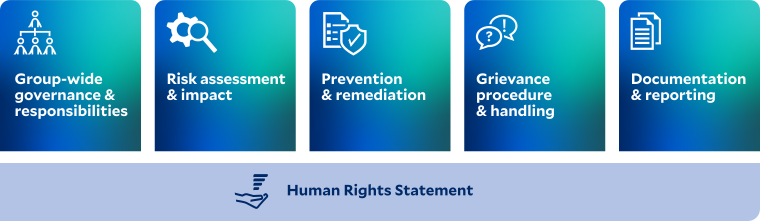
A Group-wide Standard Operating Procedure (gSOP) on implementation of Human Rights Due Diligence defines the underlying processes. The gSOP describes the responsibilities for implementing the program and contains instructions for conducting risk analyses, for handling identified human rights risks, and for documenting activities and reporting.
Where applicable, the responsible Operating Companies and departments define relevant processes to be considered in their respective operational activities. These include, e.g., ethical issues in research, development and clinical trials, or the handling of conflict minerals.
Fresenius does not purchase conflict minerals directly. However, it cannot be completely ruled out that such materials have been processed in purchased components, semifinished products and finished products, that the company sources and further processes or use in its own products. In this case, the relevant Group and Operating Companies Codes of Conduct for dealing with suppliers and other business partners apply.
Group-wide governance and responsibilities
Operational implementation of the Human Rights Statement and the Human Rights Program is ensured through Group-wide governance and clear responsibilities within the Operating Companies and at Group level.
Group-wide Human Rights governance
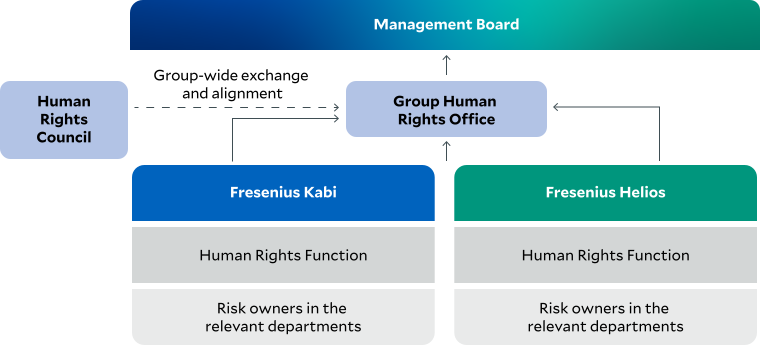
The Management Board oversees the Group-wide Human Rights Program. The Group function Risk & Integrity reports directly to the Sustainability Board member. Within this Group function, the Group Human Rights Office is responsible for the Group-wide human rights due diligence approach, such as the Human Rights Risk Assessment methodology and supports the Operating Companies in implementing processes. In addition, the Group Human Rights Office monitors their activities to ensure compliance with human rights due diligence obligations and tracks relevant legal and regulatory developments.
Each Operating Company has appointed a Human Rights Function that is responsible for implementing the Human Rights Program in the respective Operating Company.
Fresenius has appointed risk owners for relevant departments. As subject matter experts, the risk owners are responsible for the implementation of risk analyses and implementing corresponding preventive measures in their area of responsibility –e.g., in Human Resources, Procurement, or Occupational Health and Safety. They regularly report the results of the risk assessment and the status of implementing relevant activities to the respective Human Rights Function of their Operating Company.
To promote the exchange of information on current human-rights-related initiatives and topics within the Group, Fresenius has set up a Human Rights Council. It meets quarterly and is made up of representatives from various functions, such as Compliance, Sustainability, Communication, and Procurement, as well as the Human Rights Functions and the Group Human Rights Office.
Assurance functions at both Group and Operating Company levels integrate relevant aspects of the program into their activities, such as conducting audits and testing internal controls. Information on responsibilities and requirements for the Management Board as well as the Supervisory Board are explained in standard ESRS 2 General disclosures, section GOV-1 Sustainability organization. Further information regarding the monitoring processes can be found in the topical standard G1 Business conduct.
Risk assessment and impact analysis
Human rights risks can change over time. Fresenius therefore conducts annual and event-related risk analyses in its own business locations and at Tier-1 suppliers. As part of the regular risk analysis, the Fresenius Group identifies human rights issues and areas of action in all Operating Companies in accordance with the requirements of applicable international and national laws. The core of the risk evaluation addresses potential risks and negative impacts for Fresenius employees and upstream supply chain workers.
The Group follows a risk-based approach that can be divided into three phases.
Risk identification: In the first phase, Fresenius conducts an abstract risk analysis to identify potential human rights risks. This analysis incorporates both country- and industry-specific risk factors to identify potentially relevant human rights risks. For risk identification related to Tier-1 suppliers, procurement data is additionally taken into account.
Risk analyses: To evaluate which of the identified abstract risks could also be actual specific human rights risks, Fresenius conducts a so-called gap analysis in the second phase. With standardized questionnaires Fresenius records processes, responsibilities, and procedures for each potential risk area.
Risk assessment: In the final step of the risk analysis, the gaps identified are analyzed and evaluated, taking into account the impact on those affected and the likelihood of occurrence, in order to identify the relevant human rights risk areas.
Following the analyses und assessments, Fresenius derives concrete preventive recommendations for prioritized risks in order to strengthen existing processes. Information on the results of the risk analysis carried out in the reporting year can be found in this topical standard in section S2-4 Actions.
Prevention and remediation
To prevent, eliminate, or minimize human rights risks, Fresenius established appropriate standardized preventive measures such as adopting codes and guidelines and providing training. In addition, each Operating Company develops tailored prevention to the individual case within its own business and in the value chain. In cases where own business activities have caused or contributed to human rights violations, Fresenius provides appropriate and effective case-specific remediation. Further information on dealing with negative impacts can be found in this topical standard, section S2-3 Due diligence procedures and reporting channels.
Training on human rights
A central element of Fresenius’ Human Rights Program is educating the employees – not only about their personal human rights, but also about the contribution that everyone can make in their daily work. Therefore, the Group offers target group-specific training on individual human rights topics as well as a dedicated training on the Human Rights Program.
It has been rolled out successively since 2025. It imparts knowledge about individual rights and how to deal with possible human rights violations.
Raising awareness among Fresenius’ global suppliers is an important component of implementing human rights due diligence along the value chain. Therefore, Fresenius has been using the human rights training as a supporting measure in collaboration with suppliers since the second half of 2025. The selection of suppliers is based on their risk profile. The training is designed to promote awareness of human rights while strengthening cooperation with stakeholders in the value chain in order to establish common standards for ethical behavior.
Complaint procedure and processing
Fresenius values open communication and strives to create an environment in which patients, employees, members of local communities, business partners, or other potentially affected persons can report potential human rights violations. To this end, the Group has set up whistleblower systems, which are reported on in section S2-3 Due diligence procedures and reporting channels.
Documentation and reporting
In accordance with applicable laws, Fresenius continuously documents its compliance with human rights obligations. A report on the Human Rights Program and about identified risks and the respective activities is provided at least annually and as needed to the Management Board. Additional bodies such as the Audit Committee (as part of the Supervisory Board), those responsible for risk management and the internal control systems, as well as the works council are also informed. Similarly, reporting is provided to the Management Board and the management teams of the Operating Companies. In the reporting year, this included the results of the risk analysis and the further development of the Human Rights Program. The associated board resolutions and decisions are recorded in the minutes of the meetings and then communicated to relevant departments via the Human Rights Function. Further information on committees, responsibilities, and the responsibility of the Audit Committee can be found in standard ESRS 2 General disclosures.
Fresenius regularly informs its employees through various communication formats, such as the intranet, on the implementation of the Human Rights Program as well as on the prioritized risks and activities carried out. Information is made publicly available in publications such as the annual Sustainability Report as well as on the website www.fresenius.com, which Fresenius comprehensively revised during the reporting year.
The management approach stipulates that Fresenius continuously works on further developing the processes and procedures of the Human Rights Program and adapting them to regulatory developments. In addition, Fresenius engages in dialogue with various stakeholders on existing procedures as well as new approaches and concepts. These include, e.g., official advisory bodies for the implementation of human rights due diligence obligations and specialized consulting firms.
Inclusion of workers in the value chain [S2-2] Processes for engaging with value chain workers about impacts
Ensuring respect for human rights in business activities and the value chain is an important and complex task. Fresenius always conducts both the risk analyses and the conception of measures from the perspective of those affected. The Group strives to initiate and expand the dialogue with relevant internal and external stakeholders, but in particular with vulnerable stakeholder groups and their legitimate representatives. This is intended to ensure that their interests are appropriately taken into account. For processes to engage with value chain workers, the same governance structure applies as explained under S2-1.
As part of a project to define human rights priority areas and enhance stakeholder engagement, Fresenius analyzed potential adverse impacts and particularly vulnerable groups related to its business activities along the value chain in the reporting year 2025.
The results are intended to be used, among other things, for developing the group-wide approach to involving workers in the value chain. Further information on the priority areas & stakeholder engagement project can be found in this topical standard in section S2-4 Actions.
Due diligence procedures and reporting channels [S2-3] Processes to remediate negative impacts and channels for value chain workers to raise concerns
Dealing with negative impacts
The aim of any remedial measure is to end or minimize and, if possible, reverse the human rights violation. To measure effectiveness of remediation, Fresenius reviews the status of its implementation at a case-specific interval. If necessary, the company initiates further steps. A process is only considered closed when all remediation measures have been fully implemented. To address negative impacts on employees and workers in the value chain, Fresenius has developed a toolbox to provide practical support for remediation measures. This is aimed at employees involved in investigating human rights complaints. The toolbox consists of various components: These include guidance on dealing with specific human rights violations, a general guidance for remedial steps in accordance with the German Supply Chain Due Diligence Act (LkSG), a handout for evaluating the effectiveness, and information on international human rights-related standards and principles.
To further raise awareness of the appropriateness and effectiveness of preventive and remedial measures, a workshop for risk owners was held during the reporting year as part of the Human Rights Council. The aim was to provide guidance on developing appropriate and effective preventive and remedial measures.
The Operating Companies of Fresenius are also working on specific approaches to address adverse impacts. For example, Fresenius Kabi joined the Pharmaceutical Supply Chain Initiative (PSCI) during the reporting year. PSCI members commit to common ethical principles along the supply chain. This creates a consistent basis for the selection, monitoring and management of suppliers. In the reporting year, preparations were made, among other things, to contribute to the industry-wide audit pooling. These audits are intended to contribute to increasing transparency regarding working conditions in the supply chain and, where necessary, support the implementation of appropriate corrective or remedial initiatives within the pharmaceutical value chain. Audit pooling enables early identification and mitigation of supplier risks.
The insights gained from conducting such audits will be taken into account in the future development of the Human Rights Program.
Complaint mechanisms
If individuals are affected by a potential violation or have knowledge of it, Fresenius offers internal and external reporting channels. Employees of the Fresenius Group as well as external stakeholders – including those in the supply chain – can use the existing reporting channels to submit their information to the Group or the Operating Companies. Concerns related to human rights can also be submitted via a dedicated email address (humanrights@fresenius.com) or through general whistleblowing systems.
The Group provides detailed information on the process for handling incoming reports, the availability of complaint mechanisms and the various reporting channels in the topical standard G1 Business conduct. Additional information can be found in other publications, in Fresenius’ Human Rights Statement and the Group wide Codes of Conduct, as well as the Code of Conduct for Business Partners, which are available on the Fresenius website www.fresenius.com.
To further increase awareness of the reporting channels, the human rights training for employees as well as for business partners and their staff includes corresponding information.
Actions [S2-4] Taking action on material impacts on value chain workers, and approaches to managing material risks and pursuing material opportunities related to value chain workers, and effectiveness of those actions
Risk analysis and Priority Areas & Stakeholder Engagement Project
Building on previous insights from human rights risk analyses in own business operations and the Tier-1 supply chain, the existing risk analysis approach was supplemented during the reporting year by the Priority Areas & Stakeholder Engagement Project. This project expands the current risk analysis by systematically involving stakeholders. The aim of the project was to identify potential adverse impacts related to business activities along the value chain. As a result of the project, Fresenius identified the following priority areas: working conditions, labor exploitation, discrimination, access to and quality of products and services, as well as a clean and healthy environment.
Fresenius Human Rights Priority Areas

As part of the project, potentially affected rights-holders were also identified. Particular attention was given to vulnerable groups whose need for protection may arise from inherent characteristics or specific circumstances. The project was carried out in collaboration with the Operating Companies, Group functions such as Group Sustainability, Risk & Integrity, and Data Protection, as well as members of the external Sustainability Advisory Board. External perspectives were also taken into account, including input from international organisations, civil society actors, industry-related initiatives, academia, and business.
Fresenius subsequently discussed the findings with relevant stakeholders, including international trade unions (representing workers along the value chain) and the European Works Council.
This project helped to develop a better understanding of actual and potential human rights impacts on rights-holders within business operations and along global value chains. Based on the insights, the company intends to expand the dialogue with vulnerable groups or their legitimate representatives. Fresenius also plans to develop additional concrete activities or action plans containing qualitative and / or quantitative targets starting in 2026.
The described project is part of an action plan to counter the impacts and risks identified and to raise awareness about them in the deeper supply chain. This does not require significant operational expenditure (OpEx) or capital expenditure (CapEx). The necessary resources are defined on a case-by-case basis. Fresenius plans to continuously monitor the effectiveness of the measures after implementation.
Goals and ambitions [S2-5] Targets related to managing material negative impacts, advancing positive impacts, and managing material risks and opportunities
In the 2025 reporting year, Fresenius did not define a Group-wide target related to workers in the value chain.
It is the Group-wide ambition to regularly analyze human rights impacts, prevent violations, minimize risks and implement necessary remedial measures in the event of violations. This applies to the upstream and downstream value chain as well as the own operations, and for human rights impacts in connection with Fresenius’ products and services. The effectiveness of the Human Rights Program is continuously reviewed, both internally by relevant functions at Group and Operating Company levels and externally by independent auditors. As part of the further development of the Human Rights Program, Fresenius plans to formulate quantifiable targets building on this.
Metrics [MDR-M] S2-Company-specific
Reports received regarding human rights
|
|
2025 |
|
2024 |
||||
|---|---|---|---|---|---|---|---|---|
|
|
Own operations |
|
Value chain |
|
Own operations |
|
Value chain |
Reports received with human rights relevance |
|
23 |
|
1 |
|
25 |
|
3 |
Of which are substantiated |
|
1 |
|
– |
|
4 |
|
– |
Severe human rights violations |
|
– |
|
– |
|
– |
|
– |
In 2025, reports were received through Fresenius’ reporting systems that were related to human rights – broken down into those affected in own operations and those in the value chain. Of the 24 (2024: 28) reports received, 1 (2024: 4) proved to be a human rights violation.
No report was related to a severe human rights incident in the upstream or downstream value chain or in Fresenius’ own operations.
Information on incidents and remediation with relevance to violation of human rights in own operations can be found in the topical standard S1 Own workforce, section S1-17 Incidents, complaints, and severe human rights impacts.