





ESRS E1 Climate change [E1] Climate change
Disclosure requirement |
|
Title with reference |
|---|---|---|
E1 GOV-3 |
|
Integration of sustainability-related performance in incentive schemes |
E1 IRO-1 |
|
|
E1 SBM-3 |
|
Material impacts, risks, and opportunities and their interaction with strategy and business model |
E1-1 |
|
|
E1-2 |
|
Policies related to climate change mitigation and adaptation |
E1-3 |
|
Actions and resources in relation to climate change policies |
E1-4 |
|
|
E1-5 |
|
|
E1-6 |
|
|
E1-7 |
|
GHG removals and GHG mitigation projects financed through carbon credits |
E1-8 |
|
Internal carbon pricing (not material) |
E1-9 |
|
Anticipated financial effects from material physical and transition risks and potential climate-related opportunities (utilization of the phase-in option) |
Impacts, risks, and opportunities[E1 SBM-3] Material impacts, risks, and opportunities and their interaction with strategy and business model
Impacts, risks, and opportunities
Within the scope of the materiality analysis, Fresenius has identified one material impact and material risks related to Climate change:
Sub-sub-topic |
|
Type of IRO |
|
Value chain |
|
Time horizon |
|
Description |
|---|---|---|---|---|---|---|---|---|
Climate change adaptation |
||||||||
n / a |
|
Risk |
|
Own operations |
|
Mid-term |
|
Operational physical climate risk [#1] |
n / a |
|
Risk |
|
Upstream and downstream |
|
Mid-term |
|
Physical climate risks in the supply chain [#2] |
n / a |
|
Risk |
|
Own operations |
|
Mid-term |
|
Investment needs due to physical climate risks [#3] |
n / a |
|
Risk |
|
Upstream and downstream |
|
Mid-term |
|
Higher procurement costs due to physical climate risks [#4] |
n / a |
|
Risk |
|
Upstream |
|
Mid-term |
|
Climate-related transition pressure in the supply chain [#5] |
Energy / Climate change mitigation |
||||||||
n / a |
|
Actual negative impact |
|
Own operations |
|
n / a |
|
Dependence on fossil energy in own operations [#6] |
Energy |
||||||||
n / a |
|
Risk |
|
Own operations |
|
Mid-term |
|
Margin decline due to rising energy costs [#7] |
n / a |
|
Risk |
|
Own operations |
|
Mid-term |
|
Margin decrease due to internal cost pressure [#8] |
Transition plan for climate change mitigation[E1-1] Transition plan for climate change mitigation
Transition plan for climate change mitigation
As a healthcare Group, Fresenius plays an important role for society in terms of climate change adaptation. With that in mind, Fresenius aims to achieve net zero by 2050. This means the Group is reducing the Scope 1 to 3 greenhouse gas (GHG) emissions as far as possible. For the remaining unavoidable GHG emissions (maximum 10%), the company wants to offset them and will evaluate possible measures in the future, such as investing in technologies for permanent removal of CO2. At the same time, the direct levers are limited, since adjustments to the business model must always be aligned with maintaining the healthcare provision for patients. As a result, Fresenius is focusing on decarbonization through the usage of renewable energies, energy efficiency measures, and changes of technology in the production. In addition to adapting new technologies, the Group is cooperating closely with partners in the value chain to leverage the decarbonization progress across industries and sectors, for example resources with a lower carbon footprint or low-emission logistics.
The climate protection target set by Fresenius (see this topical standard, section E1-4 / E1-7 Goals and ambitions) is in line with the scientific goal of the Paris Agreement to limit global warming to 1.5°C. The Group identifies emission-intensive activities and derives reduction measures from them. To reduce Scope 1 and Scope 2 emissions, Fresenius is introducing new technologies with lower environmental impacts, which can improve the energy efficiency of processes and lead to lower GHG emissions. The focus is on the facilities that have the highest contribution to Fresenius’ carbon footprint. This enables the Company to prioritize measures and corresponding budgets that promote a timely reduction in emissions.
For the implementation of the transition plan, Fresenius has identified four central decarbonization levers:
Expansion of renewable energies: An important lever is the reduction of Group-wide electricity emissions. The Group will therefore gradually increase the purchase of electricity from renewable energy sources and further expand its self-generation of energy, e.g., through photovoltaic systems.
Increasing energy efficiency: To increase energy efficiency in buildings and processes, the Company measures the performance of relevant energy consumers and compares them with more energy-efficient systems. On this basis, optimizations, renovations, or conversions shall take place.
Fuel, technology, and process change: Fresenius plans to electrify or change processes, replace energy sources with renewable alternatives such as biofuels, or convert technologies, for example to heat pumps.
Electrification of the vehicle fleet: The Group also wants to reduce GHG emissions by replacing inefficient and high-carbon vehicles with electrically powered alternatives and expand the necessary charging infrastructure.
To address Scope 3 emissions, Fresenius is working on further developing its supplier engagement. An initial hot-spot analysis was carried out in 2024 to identify the upstream suppliers and product groups with the highest GHG intensity. In the reporting year, Fresenius intensified its engagement with relevant suppliers regarding their emissions and climate strategies.
Measures implemented and planned in the reporting year as well as related GHG emissions reduction and financial resources can be found in this topical standard, section E1-3 Actions.
The company has evaluated the most important assets and products and the associated locked-in GHG emissions. By continuously reducing the emissions through targeted measures at its own sites and buildings, the carbon footprint of its products is also gradually reduced. The planned path to achieving the climate target took the locked-in GHG emissions into account. A significant change in the future GHG emissions is not to be expected from the potential locked-in GHG emissions. The impacts of growth and acquisitions on GHG emissions are also taken into account for the target achievement. The emissions of the assets are partly associated with transitional risks: due to future regulation such as CO2 pricing, respective emissions can have a financial impact. However, it is not currently foreseeable that this would jeopardize the achievement of Fresenius’ climate targets.
Transition risks are taken into account as part of the annual risk assessment. If this results in necessary countermeasures, these will be implemented accordingly and explained in future reporting.
Still, external circumstances can affect timely achievement of the GHG emissions reduction target. New technologies such as industrial electricity storage or batteries for renewable energies are available to some extent, but they are not yet always scalable or may be associated with high costs. In addition, rare earth elements are increasingly being used in new technologies, and may be limited in availability. Furthermore, there is a possibility that increasing electrification and demand for green energy will negatively impact availability and existing infrastructure. Insufficient expansion could therefore slow down progress towards the emission reduction targets. Overall, global developments such as economic crises, natural disasters, pandemics, international tensions, and regulatory uncertainty could delay or prevent the achievement of targets. To counteract this, Fresenius tries to adapt measures to the respective situation at an early stage if necessary, thus adhering to the planned reduction paths.
Fresenius reports on targets and plans (CapEx, CapEx plans, OpEx) for aligning economic activities with the criteria set out in the Commission Delegated Regulation (EU) 2021 / 2139 in the section Disclosures pursuant to Article 8 of Regulation (EU) 2020 / 852 (EU Taxonomy Regulation).
The Group did not invest any significant amounts of CapEx in connection with economic activities related to the coal, oil, or gas sectors.
Fresenius is not subject to any of the criteria set out in Article 12.1 in EU 2020 / 1818, which is why the Group is excluded from the EU reference values agreed in Paris.
The transition plan is integrated into the general business strategy as well as the overall financial planning of Fresenius. The responsible management committees approve the components of the transition plan, such as measures and projects, as part of the budget planning process. The climate target has been approved by the Management Board of Fresenius.
2020 is the base year of the climate target for 2030. Since then, Fresenius has reduced 33.3% of its Scope 1 and Scope 2 emissions, and is therefore on track to meet its climate targets. In the reporting year, measures to expand the use of renewable energy and to increase energy efficiency particularly contributed to the long-term achievement of greenhouse gas neutrality. For more information, please also refer in this topical standard to section E1-3 Actions, to section E1-4 / E1-7 Goals and ambitions, as well as Metrics, E1-6 GHG emissions.
Approach[E1-2] Policies related to climate change mitigation and adaptation
Environmental Policy
Fresenius’ ambition in climate and environmental protection is to go beyond the legal requirements and to identify opportunities to minimize the impact on the climate and the environment. Fresenius strives to combine environmental protection activities in order to manage material impacts, risks, and opportunities in connection with climate change mitigation, climate change adaptation, and energy consumption across the Group. The Group-wide Environmental Policy is the framework for the centralized environmental management. In this policy, the company demonstrates its principles of sound environmental management practices, provides an overview of priorities in environmental protection – such as preventing environmental pollution – and outline key elements of its approach. These are: climate protection, water, as well as resources and circular economy. The policy is intended to initiate and implement measures tailored to these topics and the defined impacts, risks, and opportunities. With this framework, Fresenius also actively encourages the Operating Companies to engage in adaptation measures. The policy is intended to further anchor the ambitions for increasing energy efficiency and the use of renewable energies beyond what has already been achieved. The Environmental Policy is published on the corporate website www.fresenius.com.
The Environmental Policy applies across the Group and must be adhered to by all Operating Companies, the company’s own workforce, and third parties who work at Fresenius’ locations. The policy also lays out the expectations for the upstream and downstream value chain. For example, the Groups expects its business partners to support its environmental approach and to comply with the requirements stipulated in the respective relevant documents.
The Environmental Policy was reviewed and approved by the Fresenius Management Board. The Sustainability Board member is responsible for steering strategic Group-wide guidelines on environmental protection. The management of the Operating Companies are responsible for operational management and define the management approaches and regulate responsibility for environmental topics, for example, via a business allocation plan.
Information on responsibilities and requirements for the Management Board as well as the Supervisory Board are explained in standard ESRS 2 General disclosures, section GOV-1 Sustainability organization.
Further environmental and energy management concepts
Beyond the Group-wide Environmental Policy, all locations are subject to respective local regulations and laws. In addition, internal guidelines on environmental protection are implemented, for example specific regulations on how employees should handle hazardous substances or waste.
Since the requirements in the Operating Companies differ, environmental management is decentralized and organized according to the respective business model. They have set up additional local, regional, or global management systems. Management manuals and standard operating procedures provide the framework for the local environmental and energy management system, in accordance with the Group-wide policy. These can include detailed requirements for evaluating environmental protection measures and processes for assessing environmental risks. Business partners are also addressed and encouraged to support the respective environmental approach.
The ISO 14001 standard provides a common basis for the environmental management systems; the ISO 50001 standard is used for the energy management. The company has its systems reviewed by external partners and regulatory bodies and is expanding the number of sites certified according to ISO 14001 and ISO 50001 continuously.
Monitoring processes
Fresenius verifies the effectiveness of the management systems through internal and independent audits. The external certification audits are carried out, for example, according to a multi-site procedure. In this process, a representative sample of locations is audited annually. In 2025, the prescribed audits were carried out in the Operating Companies. No systematic deviations were identified in the process.
Each Operating Company has functions that monitor and control the respective environmental impacts. They analyze environmentally relevant vulnerabilities, develop suitable standard procedures, and implement appropriate measures. They also support their certified local entities in effective, directed environmental goal setting, monitoring these goals as well as developing and implementing mandatory guidelines for all entities. Relevant environmental data, such as consumption, is reported regularly, for example quarterly, to the responsible central function for performance control. If significant deviations from previous performance occur, Fresenius’ specialists initiate an analysis that is evaluated, and corrective or preventive actions are implemented where necessary.
Actions [E1-3] Actions and resources in relation to climate change policies
In the reporting year, the main focus was on energy saving and efficiency, process changes, as well as conversion to green electricity. Fresenius implemented the measures described below in the reporting year, is currently implementing them, or has planned to implement them and included them in the budget planning up to 2028. The measures only include the Group’s own operations. In line with the Environmental Policy, the measures contribute to reducing the GHG footprint and help achieve the Group climate targets, particularly with regard to Scope 1 and Scope 2 emissions. Further, no significant additional financial or human resources beyond the regular budget processes were required.
Further information about the reduction in GHG emissions achieved and expected through the decarbonization levers and the financial resources allocated to the transition plan are shown in the table below.
Achieved GHG emission reductions (2025)1 |
|
Double-digit percentage of base year emissions |
||||
|---|---|---|---|---|---|---|
Expected GHG emission reductions (2026–2028) |
|
At least low single-digit percentage per year compared to the base year |
||||
Financial resources allocated to transition plan |
|
Middle double-digit million euro amount |
||||
Financial resources allocated to transition plan |
|
Low single-digit million euro amount |
||||
Total amount of current financial resources allocated to transition plan (2025) |
|
Low double-digit million euro amount |
||||
Total amount of future financial resources allocated to transition plan (2026–2028) |
|
Low double-digit million euro amount |
||||
|
||||||
Expansion of renewable energies
The company obtains a large proportion of the energy used from external suppliers. This also includes renewable energies such as hydro, solar, and wind power. In addition, Fresenius examines the further use of renewable energies and generates its own heat and electricity at numerous production and hospital sites using biomass boilers and photovoltaic systems, for example.
The use of renewable energy is part of the Environmental Policy and an important part of achieving the climate target. In 2025, Fresenius used approximately 905,385 MWh (2024: 853,194 MWh) of energy from renewable energy sources. This includes energy from photovoltaic and biomass plants or from thermal and electrical cogeneration and pellet boilers. The company also purchased carbon-neutral and low-carbon electricity, district heating, and district cooling.
By 2030, Fresenius wants to obtain as much of electricity as possible from renewable sources. To this end, the company generates its own electricity using photovoltaic systems and uses energy supply contracts, or energy attribute certificates (EACs). Electricity consumption resulting from the company’s growth up to 2040 and 2050 will also come from green electricity sources. In the reporting year, additional sites were equipped with photovoltaic systems.
Increase in energy efficiency
In accordance with the Environmental Policy, Fresenius wants to place a focus on energy efficiency to achieve the climate targets for 2030 and 2040. In 2025, the Group has continuously implemented and is currently implementing a large number of measures to this end.
To increase energy efficiency in buildings and processes, the company takes a strategic approach. By improved system monitoring, inefficiencies in the energy use of heating, ventilation, and air conditioning (HVAC) systems as well as lighting can be identified at an early stage. Fresenius measures the performance of relevant energy consumers and compares them with more energy-efficient systems. This ultimately forms the basis for decisions on retrofitting. In this way, both efficient and economically viable solutions are implemented.
In the production area, Fresenius has implemented efficiency measures such as the replacement of technology and pumps, the reuse of condensate and energy, optimized steam consumption, leakage control, and the system design of compressed air. In addition, individual parts were exchanged and appliances replaced with more efficient models. The company has improved the performance of cooled and heated machines by refurbishing them or replacing them with newer appliances. The additional insulation of buildings and technology, e.g., pipes and valves, has also contributed to reducing energy consumption in 2025.
In 2022, Fresenius Helios in Germany drew up a 100-point checklist to help clinics identify potential energy savings. The 100 points on the checklist include measures such as the analysis and optimization of building heating and ventilation systems. The checklist was used throughout the reporting year, helping to reduce energy consumption.
As part of Fresenius’ ambitions with regard to energy efficiency and savings, uninterrupted energy supply is always a top priority in order to ensure the safety of patients as well as reliable production and supply. The energy-saving measures are also geared towards this.
Fuel, technology, and process change
When evaluating fuel, technology, or process changes in order to reduce GHG emissions, the company continuously considers several factors. The relevant criteria for investment decisions for new technologies are availability, cost-effectiveness, scalability, environmental compatibility, and reliability.
In the hospitals, the focus is on replacing or capturing anesthetic gases, among other things. Anesthetic gases used in the operating theatre or intensive care units are released into the outside air via the exhaust air system – where they are more harmful to the climate than CO2. Therefore, anesthetic gases cause a relevant part of the GHG emissions in the hospitals. The replacement or capturing of anesthetic gases are therefore levers in environmental and climate protection. In the reporting year, the company continued to work on successively replacing or capturing certain anesthetic gases in the hospitals with more environmentally friendly gases. In Spain, two gas types were replaced with a lower CO2 alternative. Besides, minimal-flow techniques are promoted and alternative anesthetic methods are offered to reduce the gas consumption in total. In Germany, all intensive care units have been equipped with systems for capturing the anesthetic gases used. The effects of this measure will be taken into account in the calculation of the GHG emissions reduction starting with the 2026 reporting year.
Projects are being implemented at the production sites of Fresenius Kabi to reduce steam consumption and install heat pumps.
In the production of pharmaceutical products, Water for Injection (WFI) is an important component. WFI is highly purified water whose quality exceeds that of drinking water. In 2025, Fresenius Kabi started projects in two production sites changing the production of WFI to a process requiring substantial less energy and water.
Electrification of the vehicle fleet
In the reporting year, the electrification of the vehicle fleet advanced. Fresenius Kabi continued to replace both additional vehicles and trucks in plant traffic with electric alternatives. To promote e-mobility, Fresenius is expanding the availability of charging stations at sites to enable local supply in the future. Senior executives in the segment Corporate / Other as well as at Fresenius Kabi in Germany can now only choose electric or hybrid vehicles as company cars.
Monitoring and renewal of equipment
In 2025, Fresenius introduced process monitoring and control systems at relevant sites to better manage the consumption of energy, improve data quality, and identify inefficient processes and machines. As part of this, Fresenius has replaced a large number of machines (e.g., compressors, motors, pumps) with more efficient and lower-emission alternatives.
Goals and ambitions[E1-4] Targets related to climate change mitigation and adaptation [E1-7] GHG removals and GHG mitigation projects financed through carbon credits
In the Environmental Policy, Fresenius has committed itself to reducing the GHG footprint. The company aims to reduce its negative impacts on the environment and has set GHG reduction targets in accordance with the Paris Agreement.
Group climate targets1:
Reduction by 50% by 2030: By 2030, Fresenius aims to reduce all Scope 1 and Scope 2 emissions in absolute value by 50% (gross), compared to the base year 2020.2,3
Greenhouse gas neutrality by 2040: Fresenius aims to achieve greenhouse gas neutrality in its own operations (Scope 1 and 2) across the Group by 2040. Fresenius therefore wants to reduce the absolute value of Scope 1 and Scope 2 emissions by 100% compared to the base year 2020. To achieve this, it plans to eliminate all avoidable GHG emissions (at least 90% gross reduction); unavoidable emissions (maximum 10%) are to be offset through measures to permanently remove CO2 in the future.3
Net zero by 2050: Fresenius wants to achieve net zero along the entire value chain (Scope 1 to 3) by 2050 at the latest. To achieve this, the Group plans to eliminate all avoidable THG emissions (at least 90% gross reduction); unavoidable emissions (maximum 10%) are to be offset through measures to permanently remove CO2 in the future.
The data on which the climate targets are based can be found in this topical standard, Metrics section, E1-5 Energy consumption and energy mix as well as E1-6 GHG emissions.
The reduction of Scope 1 and Scope 2 emissions is also included as an ESG criterion in the long-term variable Management Board compensation (Long Term Incentive – LTI) at a rate of 25%. Further information can be found in the standard ESRS 2 General disclosures section GOV-3 ESG targets in the compensation of the Management Board.
1 For the Group targets, Fresenius calculates Scope 2 emissions in accordance with the Greenhouse Gas Protocol using the market-based calculation approach. The recorded greenhouse gases (CO2, CH4, N2O, HFKW, PFC, SF6, and NF3) are converted into CO2 equivalents. The Group targets include all financially consolidated units of Fresenius SE & Co. KGaA; the GHG emissions, which are reported under E1-6, correspond to the same reporting scope (financial scope of consolidation). E1-6 also includes Scope 3 emissions, which are not currently covered by the target of greenhouse gas neutrality by 2040.
2 The reduction target comprises the total emissions of both categories and the target achievement is not analyzed separately by Scope 1 and Scope 2. Of the total amount to be reduced, about 45.9% relates to Scope 1 emissions and about 54.1% relates to Scope 2 emissions.
3 Fresenius has an internal recalculation policy that defines a correction of the base value and its triggers. In 2025, the base value was adjusted because the calculation methodology was revised to comply with regulatory requirements. The base-year value of 708,364 t CO2e was increased by 22,680 t CO2e. This adjustment ensures comparability with the reporting year. The targets themselves were not adjusted. The adjustment has no effect on the target achievement as the previous years and the reporting year were recalculated considering the same scope. The base year 2020 is representative in terms of business performance, the available prior-year figures, the associated data quality, and industry benchmarking. Prior-year data was compared accordingly and placed in the business context. if external factors would have an impact, they have been taken into account.
Target setting
Fresenius’ targets – reduction by 50% by 2030, greenhouse gas neutrality by 2040 and net zero by 2050 – are in line with the scientific goal of the Paris Climate Agreement to limit global warming to 1.5°C. German and European climate targets and the guidelines of the Science Based Targets initiative (SBTi) were also used as guidelines for setting targets. The target to reduce Scope 1 and 2 emissions by 2030 is guided by the criteria for near-term targets defined by the SBTi. Fresenius’ targets have not been validated by SBTi.
The SBTi cross-sector decarbonization path was used as a guideline for setting the targets. Sector-specific decarbonization paths were not utilized. Future economic growth and potentially increasing GHG emissions depending on business activities and energy sources used were taken into account in target setting. The assumed future GHG emissions were extrapolated on the basis of the previous year’s figures up to the target year and included in the target setting in order to take them into account accordingly in the action planning. It was assumed that growth will be low-carbon or carbon-neutral due to the development of new climate-friendly technologies and their industrial scaling.
Internal and external stakeholder expectations were taken into account when setting the objectives by considering, for example, investor requirements, initiatives, guidelines, public opinions, and customers’ and employees’ expectations. Corporate strategy and national requirements were also taken into account. The scope, time horizon, and reduction targets were determined on the basis of internal analyses and benchmarking.
The base value of the targets was adjusted in the reporting year; further information on this can be found under Group climate targets. Details about estimates made can be found in the following Metrics section, E1-5 Energy consumption and energy mix as well as E1-6 GHG emissions.
Fresenius continuously evaluates possible decarbonization levers to achieve the long-term climate targets. In addition to the use of existing technologies, the company also considers new technologies, as described in this topical standard, section E1-3 Actions.
The company reviews its GHG emissions figures on a quarterly basis and monitors the achievement of targets. In doing so, progress is assessed in comparison to the base year and target year as well as the annual reduction steps. Fresenius evaluates any deviations and takes countermeasures if necessary. The progress is currently in line with the planning. Since 2020, the Group has effectively reduced emissions with the help of decarbonization levers, e.g., the increasing use of renewable energies or their equivalent certificates (see this topical standard, section E1-3 Actions). No GHG emission reductions achieved before the base year 2020 are taken into account in target achievement.
Approach to reduce remaining emissions
To achieve the targets of greenhouse gas neutrality by 2040 as well as net zero by 2050, in principle, Fresenius wants to reduce all GHG emissions as far as possible by means of measures within its own business activities as well as the upstream and downstream value chain as a first step. Therefore, the target for 2030 already provides for a 50% reduction in Scope 1 and Scope 2 emissions in absolute terms. The company is focusing on reducing Scope 2 emissions initially, as technological solutions are available globally. Scope 1 emissions, in contrast, are anchored in processes and require a long-term planning horizon. The focus is on the decarbonization levers of increasing energy efficiency as well as fuel, technology, and process change as described in this topical standard, section E1-1 Transition plan for climate change mitigation.
Only subsequently, in a second step, will activities for the reduction (carbon credits) or permanent removal of CO2 be considered in order to offset unavoidable GHG emissions. To this end, the Group has stipulated that a maximum of 10% of emissions will be neutralized through reduction or removal and storage activities within and outside own business activities and the upstream and downstream value chain.
Fresenius does not currently carry out any activities to reduce greenhouse gases via carbon removal, carbon storage, or carbon credits.
Metrics1
1 Starting in fiscal year 2025, the remaining units of Fresenius Vamed will no longer be included in the environmental data. According to the recalculation policy, the change compared to the previous year is insignificant, so no recalculation was performed.
Energy consumption and energy mix [E1-5] Energy consumption and mix
In 2025, Fresenius consumed a total of 2,936,900 MWh of energy, representing a 5.0% reduction compared to the previous year (2024: 3,090,443 MWh). In the reporting year, the Group again focused its activities on energy-efficiency measures and expanding the use of renewable energies throughout the Group. The main energy sources were gas and electricity.
In January 2026, one of the Helios hospitals in Berlin was affected by a large-scale power outage. The emergency power system was able to maintain the hospital’s electricity supply until the public power supply was restored. The corresponding oil consumption will be included in the metrics for the 2026 reporting year.
in MWh |
|
2025 |
|
2024 |
|---|---|---|---|---|
Total fossil energy consumption |
|
1,962,068 |
|
2,147,576 |
Fuel consumption from coal and coal products |
|
– |
|
– |
Fuel consumption from crude oil and petroleum products |
|
201,062 |
|
215,594 |
Fuel consumption from natural gas |
|
1,162,522 |
|
1,233,819 |
Fuel consumption from other fossil sources |
|
– |
|
– |
Consumption of purchased or acquired electricity, heat, steam, and cooling from fossil sources |
|
598,483 |
|
698,162 |
Share of fossil sources in total energy consumption |
|
66.8% |
|
69.5% |
Consumption from nuclear sources |
|
69,447 |
|
89,673 |
Share of consumption from nuclear sources in total energy consumption |
|
2.4% |
|
2.9% |
Total renewable energy consumption |
|
905,385 |
|
853,194 |
Fuel consumption from renewable sources |
|
86,400 |
|
89,221 |
Consumption of purchased or acquired electricity, heat, steam, and cooling from renewable sources |
|
801,923 |
|
750,046 |
Consumption of self-generated non-fuel renewable energy |
|
17,062 |
|
13,927 |
Share of renewable sources in total energy consumption |
|
30.8% |
|
27.6% |
Total energy consumption |
|
2,936,900 |
|
3,090,443 |
Non-renewable energy production |
|
94,384 |
|
109,623 |
Renewable energy production |
|
17,072 |
|
13,949 |
in MWh / €1 million revenue |
|
2025 |
|
2024 |
||||
|---|---|---|---|---|---|---|---|---|
Total energy consumption per net revenue |
|
130 |
|
134 |
||||
|
||||||||
|
|
2025 |
|
2024 |
||||||
|---|---|---|---|---|---|---|---|---|---|---|
Total energy consumption from activities in high climate impact sectors, in MWh |
|
1,733,176 |
|
1,771,418 |
||||||
Total energy consumption from activities in high climate impact sectors per net revenue from activities in high climate impact sectors2, in MWh / €1 million revenue |
|
202 |
|
206 |
||||||
|
||||||||||
For the calculation, fossil energy consumption of the company’s own business was totaled according to the respective energy sources (e.g., natural gas, diesel, liquefied natural gas (LNG)) based on measurement counter, invoices, or estimates. Individual energy sources were determined based on the amount consumed and their gross calorific value. For presentation in the Sustainability Statement, the totaled data were converted to the lower heating value (LHV). If no data was available, the energy consumption was extrapolated using reference values. The energy consumption of the following units is based on data per FTE (full-time equivalent) collected at the Bad Homburg site: outpatient clinics of Fresenius Helios in Germany, offices, research & development sites, locations with unavailable data, and employees of the segment Corporate / Other outside Bad Homburg.
The energy consumption of Fresenius Helios in Spain’s outpatient health centers, for which no energy data was available, was extrapolated based on the average energy consumption per square meter, using data from the reporting outpatient health centers. This method is better aligned with the business activities than the one applied up to the 2024 reporting year.
The nuclear share of electricity, district cooling and heating consumed in the upstream supply chain was calculated and totaled proportionately for each country using statistical country information. The data basis was the database of the International Energy Agency (IEA). The majority of production sites use electricity from renewable sources for upstream cooling processes. In the production sites’ upstream supply chain, the assumption is made that natural gas is mainly used as an energy source for steam.
The renewable energy consumption of the company’s own business was totaled according to the respective renewable energy sources (e.g., biomass pellets, biogas). Individual energy sources were determined based on the amount consumed and their gross calorific value. Purchased green electricity certificates were taken into account accordingly. When green electricity claims are received from national grid consumption, the last available evidence was used. In some cases, this was from the previous year. The data was converted to the LHV for presentation in the Sustainability Statement.
Sites with ISO 50001 certification are audited by an external auditor, e.g., MSZert or TÜV.
GHG emissions1, 2 [E1-6] Gross Scopes 1, 2, 3 and total GHG emissions
In the reporting year, Fresenius generated a total of 4,258,997 t CO2e (2024: 4,289,740 t CO2e).
The Scope 1 emissions account for 317,448 t CO2e and decreased by 9.6% compared to the previous year (2024: 351,128 t CO2e). Scope 2 emissions (market-based) account for 170,497 t CO2e and decreased by 9.0% compared to the previous year (2024: 187,300 t CO2e). The Scope 2 emissions calculated according to the location-based approach amounted to 405,513 t of CO2e (2024: 447,563 t CO2e). The reduction was mainly achieved through energy efficiency measures, process changes, and the expansion of renewable energy use. Further information on the measures implemented can be found in the section E1-3 Actions in this topical standard.
Scope 3 emissions amounted to 3,771,052 t CO2e in the reporting year. This represents an increase of 0.5% over the previous year (2024: 3,751,312 t CO2e). The increase is due, among other factors, to the expansion of business operations and the resulting higher purchasing volumes as well as higher emission intensities of purchased products and services.
Scope 1 & Scope 2 target path
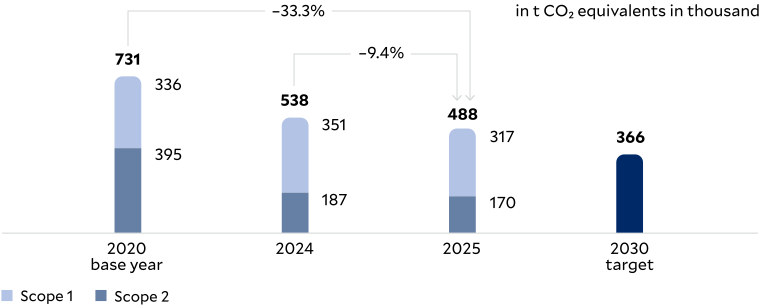
In comparison to the 2020 base year, the company reduced the total Scope 1 and 2 emissions (market-based) by about 33.3% to 487,945 t CO2e3. This puts Fresenius on track to meet its Group climate targets.
Biogenic Scope 1 emissions were 34,870 t CO2e in the reporting year (2024: 36,892 t CO2e).
You will find the GHG emissions table at the end of this topical standard, with detailed information on Scope 1, Scope 2, and Scope 3.
1 The Scope 1 and Scope 2 GHG emissions relate exclusively to the entities included in the defined reporting scope (financially consolidated entities of Fresenius SE & Co. KGaA). Fresenius does not hold any reporting-obligated investee companies as defined by the CSRD. Accordingly, no other data is included in the calculation of Scope 1 and Scope 2.
2 The following values from the previous year have been adjusted to ensure comparability with the 2025 figures. The adjustment results from a modification of the calculation methodology, internal insights, and an improved data collection process. The prior-year value of total GHG emissions (market-based) of 4,199,344 t CO2e was increased by 90,397 t CO2e. The prior-year value of total GHG emissions (location-based) of 4,482,069 t CO2e was increased by 67,934 t CO2e. The prior-year value of Scope 2 emissions (market-based) of 164,838 t CO2e was increased by 22,462 t CO2e. The prior-year value of Scope 3 emissions of 3,683,377 t CO2e was increased by 67,934 t CO2e.
3 The indicator total Scope 1 and 2 emissions (market-based) as part of the long-term variable compensation (LTI) of the Management Board are assured with reasonable assurance, as explained on pages 431 ff. in the assurance report of the independent german public auditor.
in % |
|
2025 |
|
2024 |
|---|---|---|---|---|
Purchase |
|
|
|
|
Share of bundled renewable energy certificates |
|
0.7 |
|
2.3 |
Share of unbundled renewable energy certificates |
|
49.8 |
|
41.7 |
Sale |
|
|
|
|
Share of bundled renewable energy certificates |
|
– |
|
– |
Share of unbundled renewable energy certificates |
|
– |
|
– |
When purchasing energy, Fresenius uses contractual agreements that come with various options for energy attributes such as guarantees of origin or renewable energy certificates. The table above shows the contractual options used for energy purchases and their respective extent.
The share of bundled renewable energy certificates includes energy that is purchased together with the physical electricity as part of the same contract. Fresenius uses guarantees of origin, green electricity tariffs, and power purchase agreements.
The share of unbundled renewable energy certificates describes energy property claims that are purchased from third parties who do not provide the physical energy. Fresenius uses purchased guarantees of origin for renewable energy claims.
The percentage share is set in relation to the energy consumption on which the Scope 2 emissions are based.
in t CO2e /€1 million revenue |
|
2025 |
|
2024 |
||||||
|---|---|---|---|---|---|---|---|---|---|---|
GHG emissions (location-based) per net revenue |
|
199 |
|
197 |
||||||
GHG emissions (market-based) per net revenue |
|
189 |
|
186 |
||||||
|
||||||||||
The following definitions and methods are used to calculate the GHG emissions.
Scope 1 and 2 emissions
The selected emission factors for calculating Scope 1 and 2 emission comply with the requirements and guidance of the GHG Protocol Corporate Standard. CO2e emission factors were selected based on topicality and availability.
Scope 1 emissions: The energy consumed (higher heating value – HHV) was multiplied by the respective CO2e conversion factor (DEFRA) and added together. Fugitive emissions were calculated on the basis of the Global Warming Potential using the latest published IPCC values (Assessment Report 6). Scope 1 emissions from regulated emissions trading systems are disclosed based on the latest available reported data, which could be from the previous year.
Biogenic Scope 1 emissions: The consumption of energy obtained from biomass was multiplied by the corresponding CO2 conversion factor (DEFRA). As the Group has no further information, it is assumed that biomass was burned and not degraded.
Scope 2 emissions (location-based): The amount of electricity consumed was multiplied by a country-specific CO2e conversion factor from the IEA. The steam, district heating, and district cooling consumed were multiplied by a uniform CO2e conversion factor (DEFRA) or US Energy Information Administration (US EIA). The conversion factors used do not include CO2e emissions for biogenic emissions.
Scope 2 emissions (location-based / market-based biogenic emissions): A calculation could not be carried out due to unavailable emission factors. The emission factors available did not fully cover the biogenic emissions from energy conversion.
Scope 2 emissions (market-based): A hierarchy was implemented to calculate the GHG emissions. If supplier-specific emission factors were available, these were used first. If not available, country-specific EU residual mix conversion factors (AIB) were used. If these were not available, country-specific IEA or US EIA factors were used. Where country-specific conversion factors were used, the most recent version was used.
Emission streams
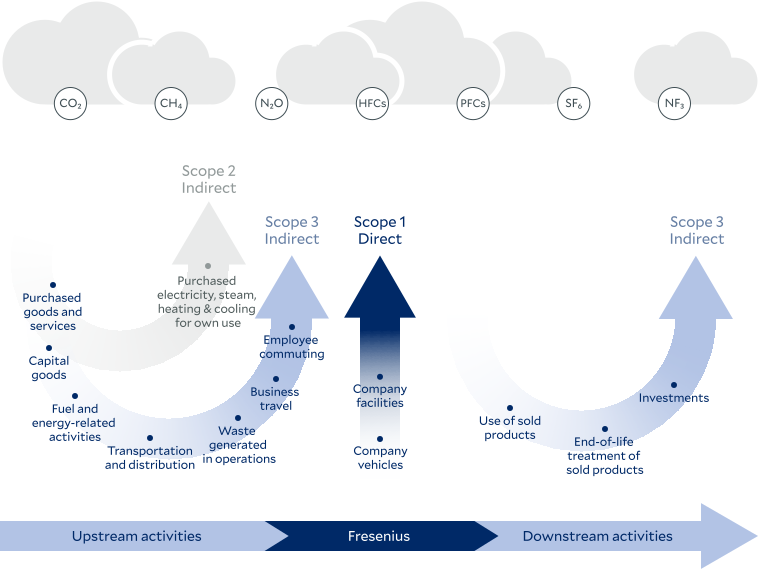
Scope 3 emissions
Scope 3 emissions include all upstream and downstream activities along the value chain. The Scope 3 emissions were disclosed in accordance with the standards set out on pages 8 and 9 of the publication A Corporate Accounting and Reporting Standard – Revised Edition of the Greenhouse Gas Protocol initiative (World Business Council for Sustainable Development / World Resources Institute). 33.0% of Scope 3 emissions are calculated using primary data obtained from suppliers or other value chain partners. The selected emission factors for Scope 3 emission calculation comply with the requirements and guidance of the GHG Protocol Corporate Standard. Unless stated otherwise, all Scope 3 categories follow the same reporting boundary as the Scope 1 and 2 emission calculation. Biogenic Scope 3 emissions are deemed non-material for Fresenius based on the business activities and used energy sources.
Category 1, 2, and 4 – Purchased goods and services, Capital goods, and Upstream transportation and distribution: The calculation is conducted with a spend-based approach according to the GHG Protocol using the multi-regional input-output analysis method estell. Spendings per product category are multiplied by the emission factors.
Category 3 – Fuel and energy-related activities (not included in Scope 1 or Scope 2): The calculation is based on the annual energy consumption data used to calculate the Scope 1 and market-based Scope 2 emissions and multiplied by a respective upstream emission factor. Current DEFRA (Well-to-Tank (WTT) emission factors), IEA and a study by the German Environment Agency are used as sources for emission factors. For electricity from renewables, a global emission factor based on the global renewable mix (IEA) is used. For electricity consumption in Germany, the German equivalent is used. For gas and fuels, the gross cv factors are applied.
Category 5 – Waste generated in operations: The calculation is based on tons of waste generated per waste type and waste treatment method, cubic meters of wastewater generated, and relevant emission factors from the sources DEFRA, and ecoinvent. Waste categories that are expected to be recycled or to end up in an energy from waste (EfW) process are accounted for as 0 according to the requirements of the GHG Protocol.
Category 6 – Business travel: For the Operating Companies, the activity data is collected via an extract from the service providers. Car rental, plane, and train data for Fresenius Helios in Spain comes directly from the travel agency. The emission factors used reflect the Well-To-Wheel (WTW) emissions from energy generation to conversion into kinetic energy on the wheel, in line with the GHG Protocol methodology and SBTi guidelines. Countries where the respective train company declares on its website that all trains are powered by renewable energy are considered with an emission factor of 0. The km traveled with each transportation method are multiplied by the corresponding distance-based emission factor.
Category 7 – Employee commuting: The number of employees per Operating Company is used as the basis for this category. The split of transportation mode is calculated on a regional level based on statistical data for individual countries (e.g., Eurostat). All data on travel distances and travel modes is based on public research. DEFRA (WTW emission factors) and ecoinvent are used as sources for emission factors. The distance-based method is applied.
Category 11 – Use of sold products: This category is only relevant for Fresenius Kabi, as Fresenius Helios has no manufacturing / production activities and subsequently no products are sold and used. Within this category, direct use-phase emissions are only generated by electrical products sold by Fresenius Kabi MedTech. Pharmaceutical products do not cause any use-phase GHG emissions and are therefore not relevant. The calculation is based on IEA emission factors. The data basis consists of sales data as well as technical information per product for each country, e.g. electrical load, full load hours per day, and lifetime.
Category 12 – End-of-life treatment of sold products: This category is only relevant for Fresenius Kabi, as all other Operating Companies have no manufacturing / production activities and subsequently no products are sold and disposed of. The methodology varies depending on the product and packaging. GHG Emissions are calculated based on sales data, weight data, and statistics on regional disposal methods. Within Fresenius Kabi, the pharmaceutical products themselves are not considered relevant as they are metabolized in the body.
Category 15 – Investments: This category includes all non-consolidated investments in which Fresenius holds a minimum interest of 20%. The share of the investment is either applied to actual emission data from the company or used to extrapolate emissions based on revenue and EEIO emission factors as stated in the GHG Protocol.
Energy consumption of locations with ISO 50001 certification is checked in an external audit, e.g., by MSZert or TÜV.
|
|
Retrospective |
||||||||||||||||
|---|---|---|---|---|---|---|---|---|---|---|---|---|---|---|---|---|---|---|
|
|
2020 (base year) |
|
2024 (comparative) |
|
2025 (N) |
|
Percentage change on previous year |
||||||||||
Scope 1 GHG emissions |
|
|
|
|
|
|
|
|
||||||||||
Gross Scope 1 GHG emissions, in t CO2e |
|
335,908 |
|
351,128 |
|
317,448 |
|
-9.6% |
||||||||||
Percentage of Scope 1 GHG emissions from regulated emission trading schemes |
|
n / a |
|
35.7% |
|
39.4% |
|
n / a |
||||||||||
Scope 2 GHG emissions |
|
|
|
|
|
|
|
|
||||||||||
Gross location-based Scope 2 GHG emissions, in t CO2e |
|
455,271 |
|
447,563 |
|
405,513 |
|
-9.4% |
||||||||||
Gross market-based Scope 2 GHG emissions, in t CO2e |
|
395,136 |
|
187,300 |
|
170,497 |
|
-9.0% |
||||||||||
Significant scope 3 GHG emissions |
|
|
|
|
|
|
|
|
||||||||||
Total Gross indirect (Scope 3) GHG emissions, in t CO2e |
|
n / a |
|
3,751,312 |
|
3,771,052 |
|
0.5% |
||||||||||
1 Purchased goods and services |
|
n / a |
|
1,634,985 |
|
1,706,509 |
|
4.4% |
||||||||||
2 Capital goods |
|
n / a |
|
143,352 |
|
109,365 |
|
-23.7% |
||||||||||
3 Fuel and energy-related activities (not included in Scope 1 or Scope 2) |
|
n / a |
|
132,886 |
|
114,597 |
|
-13.8% |
||||||||||
4 Upstream transportation and distribution |
|
n / a |
|
213,584 |
|
245,657 |
|
15.0% |
||||||||||
5 Waste generated in operations |
|
n / a |
|
38,769 |
|
36,956 |
|
-4.7% |
||||||||||
6 Business travel |
|
n / a |
|
17,423 |
|
14,624 |
|
-16.1% |
||||||||||
7 Employee commuting |
|
n / a |
|
275,317 |
|
273,810 |
|
-0.5% |
||||||||||
8 Upstream leased assets |
|
n / a |
|
n / a |
|
Emissions from the operation of assets that are leased by the reporting company in the reporting year are included in the Scope 1 and 2 GHG inventory. |
|
n / a |
||||||||||
9 Downstream transportation |
|
n / a |
|
n / a |
|
This category is insignificant in terms of emissions for Fresenius. |
|
n / a |
||||||||||
10 Processing of sold products |
|
n / a |
|
n / a |
|
This category is not part of Fresenius’ business model. |
|
n / a |
||||||||||
11 Use of sold products |
|
n / a |
|
37,050 |
|
26,272 |
|
-29.1% |
||||||||||
12 End-of-life treatment of sold products |
|
n / a |
|
103,632 |
|
110,641 |
|
6.8% |
||||||||||
13 Downstream leased assets |
|
n / a |
|
n / a |
|
This category is not part of Fresenius’ business model. |
|
n / a |
||||||||||
14 Franchises |
|
n / a |
|
n / a |
|
This category is not part of Fresenius’ business model. |
|
n / a |
||||||||||
15 Investments |
|
n / a |
|
1,154,315 |
|
1,132,621 |
|
-1.9% |
||||||||||
Total GHG emissions |
|
|
|
|
|
|
|
|
||||||||||
Total GHG emissions (location-based), in t CO2e |
|
791,178 |
|
4,550,003 |
|
4,494,013 |
|
-1.2% |
||||||||||
Total GHG emissions (market-based), in t CO2e |
|
731,044 |
|
4,289,740 |
|
4,258,997 |
|
-0.7% |
||||||||||
|
||||||||||||||||||